

Speed vs. Price in Freight Quoting: When Fast Responses Matter Most
There is no single rule that says speed always beats price in freight quoting. Sometimes the lowest number wins. Sometimes the first usable quote wins. Most of the time, the outcome depends on the shipper, the lane, the freight type, and how much certainty the buyer needs.
That is why the speed versus price debate stays messy. A quote is not just a number. It is a small decision package: how fast you answered, how complete the rate is, how much back-and-forth you caused, and whether the shipper trusts you enough to move forward.
For some freight teams, that means quoting faster is the most direct way to win more business. For others, especially on highly commoditized or heavily bid lanes, speed matters less than disciplined pricing. The real question is “In which situations does speed change the outcome?”
When speed matters most
Speed matters most when the buyer is still comparing options and has not yet anchored on a preferred carrier or broker. In those moments, the first clear, credible response can shape the rest of the conversation. The customer is not waiting to admire your process. They are moving through a live decision and trying to rule out uncertainty.
That shows up most clearly in spot freight, SMB brokerage, and middle-market shippers. These buyers often need a usable answer quickly because the quote is tied to another decision: a customer proposal, an internal approval, a shipment that needs coverage, or a lane they do not want to leave hanging.
It also matters when the freight is operationally urgent. If the shipper is under time pressure, they are less likely to wait for five more options just to save a small amount. They want a number they can trust, and they want it soon.
A fast response is especially valuable when the quote is simple enough to be completed cleanly. If the lane is familiar, the equipment is standard, and the accessorial risk is low, delays rarely help you. They just create room for another provider to get there first.
That advantage gets weaker when the freight becomes more structured and price-sensitive. Formal RFPs, recurring contract lanes, and highly benchmarked freight usually reward pricing discipline and service consistency more than response time alone.
The key is understanding which situations reward speed and which reward optimization.
Urgent or spot freight → speed matters more
Familiar lanes with known carrier coverage → speed matters more
Complex, accessorial-heavy, or volatile lanes → accuracy matters more
Long-term bid freight → price and service consistency matter more
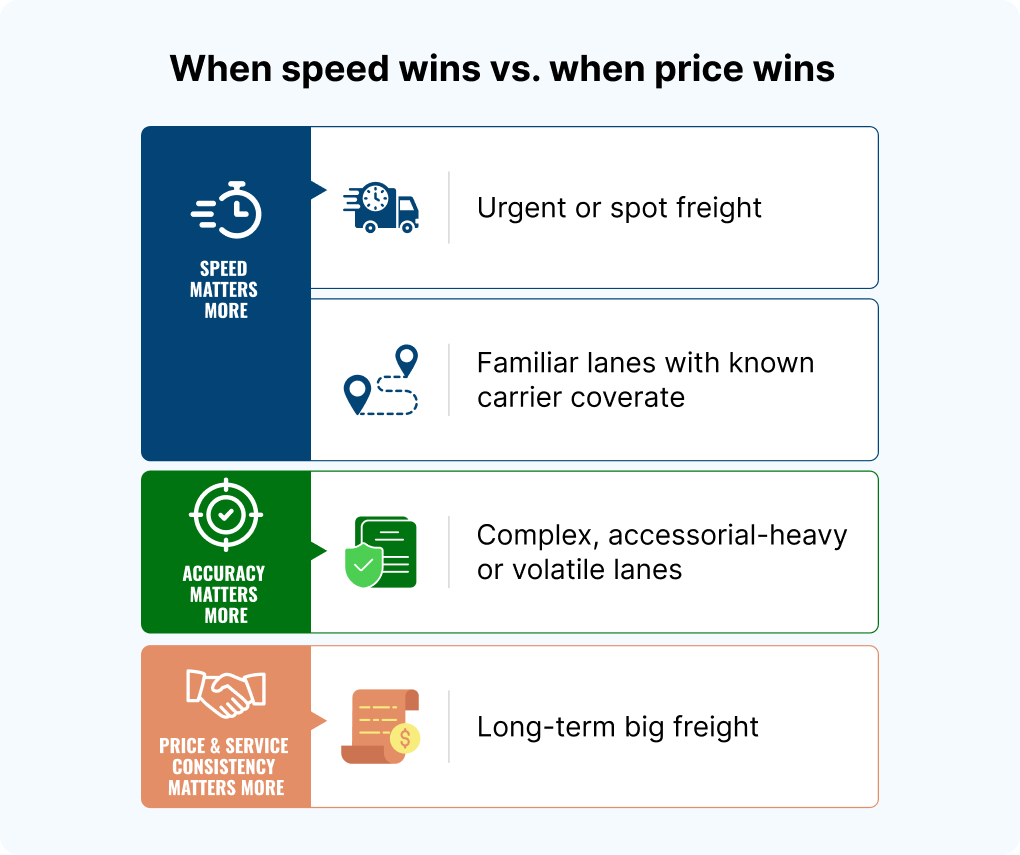
The strongest freight teams usually optimize differently depending on the lane, customer, and urgency level instead of forcing every quote through the same process.
When price still wins
Price still wins when the buying process is more formal, more competitive, or more strategic. Long-term bids, structured RFPs, and high-volume shipper relationships often reward consistency, margin discipline, and service history more than raw speed. In those cases, buyers usually have time to compare multiple responses, so a quick reply is table stakes rather than a differentiator.
Price also matters more on commoditized freight. If the lane is highly repeatable and the buyer already knows the market, then the response speed advantage shrinks. The decision becomes more about who can hold the best number, manage the service risk, and stay dependable over time.
This is where a lot of quoting advice goes wrong. It treats all freight like one market. It is not one market. A simple spot lane for a smaller shipper behaves differently from a formal multi-lane bid. Drayage behaves differently from reefer. A known lane behaves differently from an unfamiliar one.
It is not that speed stops mattering. It is that speed and price do not dominate the same way in every context.
What usually slows down freight quotes, and how better teams avoid it
Most quoting delays are not caused by the math itself. The delay usually comes from the workflow around the math.
The first slowdown is intake. Freight requests often arrive in messy formats: a short email, a screenshot, a PDF, a few lane notes, or a vague message that leaves out accessorials and timing details. Before anyone can price the move, someone has to decode the request. Better teams reduce that friction by forcing requests into structured fields: origin, destination, equipment, commodity, dates, accessorials, and service level.
The second slowdown is lookup. Teams often search old emails, shared sheets, TMS history, or rate notes to figure out whether the lane has been run before and what the market looked like last time. That step sounds simple, but it becomes expensive when the data lives in different places. Stronger teams keep rate history close to the quote workflow, not buried in random inboxes or hidden in one person’s memory.
The third slowdown is carrier coordination. If the lane is not already covered by a known network, the broker may need to check availability, make calls, wait for callbacks, or post the load. That waiting time is where many quotes lose momentum. Familiar lanes with known carrier coverage can move faster, while uncertain lanes need more review.
The fourth slowdown is risk checking. A quote is only useful if it is not quietly wrong. That means checking accessorials, special equipment, service level, margin floor, and any rules that could turn a decent number into a bad one. Better teams define margin rules early so the team does not quote too aggressively just to win speed.
The fifth slowdown is approval. Good teams do not skip approval when the quote is uncertain. But a slow approval process can turn a usable draft into a missed opportunity if there is no clean way to separate “suggested price” from “final send.”
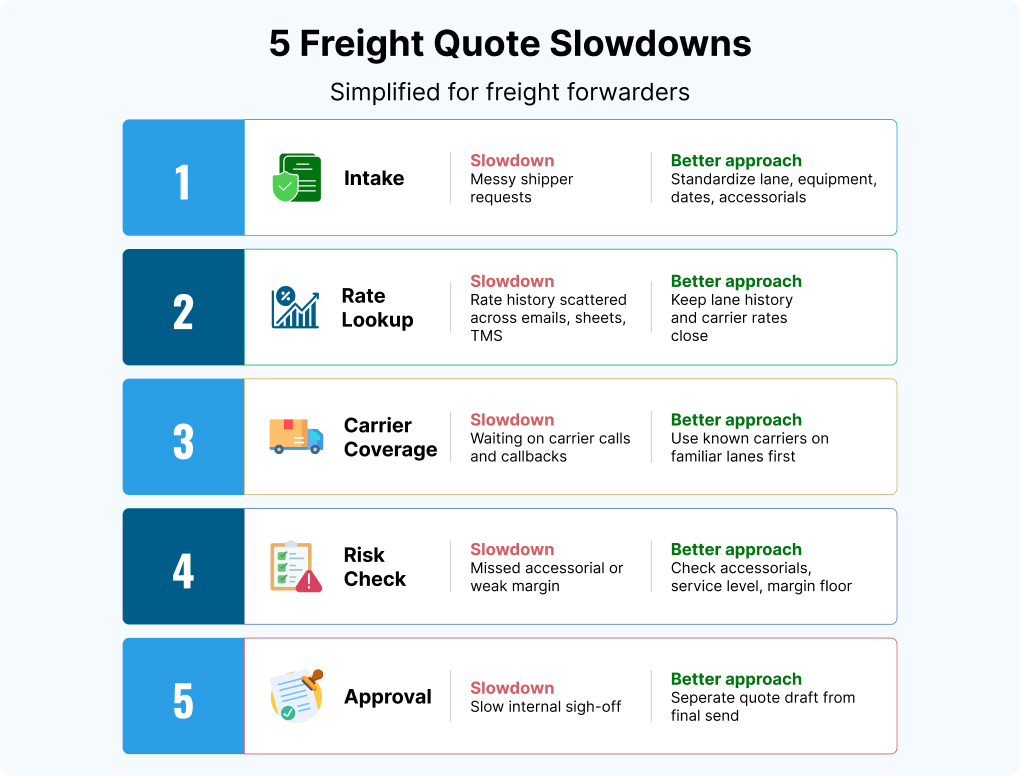
That separation matters more than people think. A quote can be generated quickly, then reviewed when the lane is unusual or the margin is tight. That gives the team speed and control at the same time.
Most of all, strong teams understand that freight quote turnaround time is not just a process metric. It is a revenue lever. The fewer unnecessary steps in the workflow, the more likely the quote reaches the shipper while the lane is still live.
Turning faster quoting into a controlled process
The real problem in freight quoting is rarely the pricing itself. It is the manual work surrounding it: digging through inboxes, reconstructing lane history, checking disconnected systems, and trying to move quickly without sending a bad number.
Wend AI helps simplify this quoting workflow by reducing the repetitive work around human judgment:
Turn messy lane requests into structured quote inputs
Surface historical lane and pricing context faster
Flag low-margin or risky quotes before sending
Route uncertain quotes through approval without slowing everything down
For SMB and middle-market freight teams handling high quote volume, the biggest gain is faster first-pass quoting without losing control over pricing decisions.
Speed does matter in freight quoting, but only in the right situations. The first usable quote often gains an advantage because it removes friction while the shipment decision is still active.
But faster is not always better. A quick quote with stale pricing, missed accessorials, or weak margin control creates a different problem later. The teams that consistently perform well are the ones that remove manual friction without removing review, judgment, or pricing discipline. That balance is what actually improves quote performance over time.